Every shared market, matched
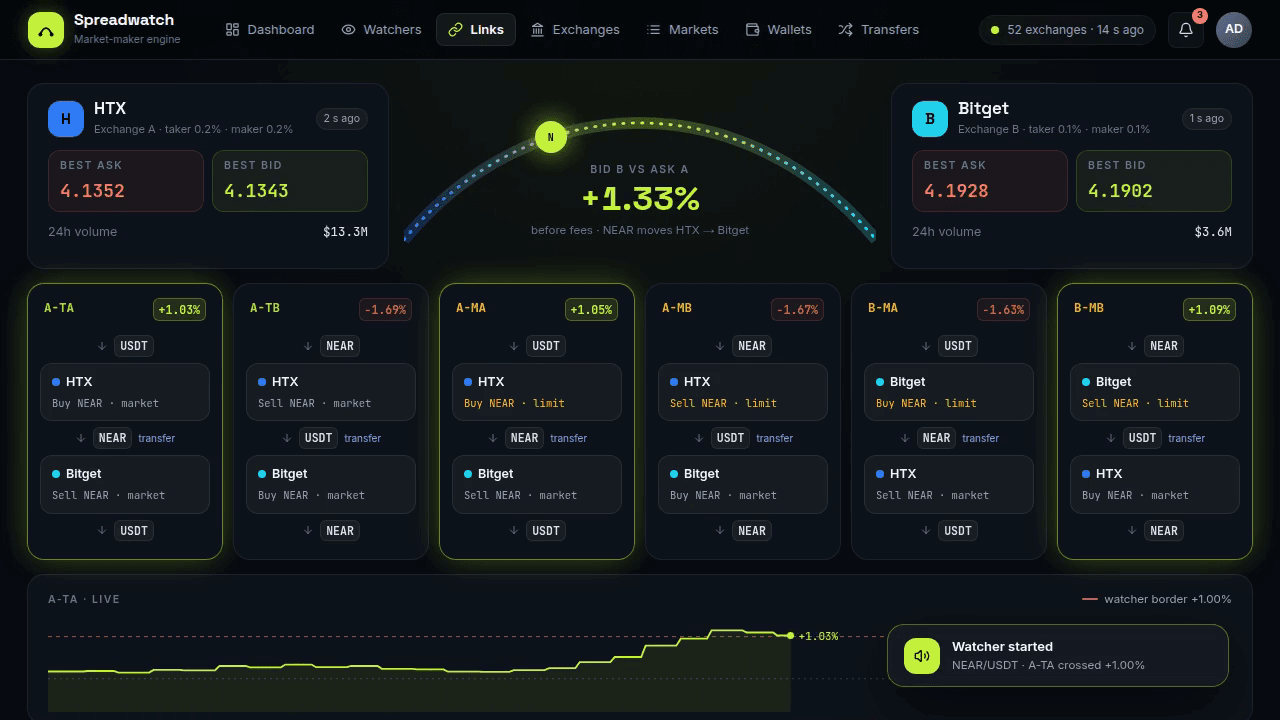
The engine matches each market an exchange lists with the same market on every other exchange, and keeps that list current as exchanges add new pairs and delist old ones.
Crypto trading · Own product
A market-maker engine that compares the same market across exchanges and finds trades that stay profitable after fees, order book depth and transfers.
The challenge
The same coin often trades at slightly different prices on different exchanges. Buy where it is cheaper, move it, sell where it is dearer: that is inter-exchange arbitrage. Finding the gaps means comparing every market an exchange shares with every other exchange, and there are thousands of such pairs.
A gap in the best prices rarely survives contact with reality. Trading fees differ by exchange and by order type, withdrawals cost money and take time, a wallet can be closed for maintenance, and the order book may hold only a few dollars at the quoted price.
I wanted an engine that looks at these gaps the way a market maker does: which trades are worth placing, how large they can be, and how much money is left once every cost is paid.
The approach
The engine matches each market an exchange lists with the same market on every other exchange, and keeps that list current as exchanges add new pairs and delist old ones.
Every market pair is priced for several trade scenarios, each with the fees the exchange charges for that kind of trade, so the spread on screen is close to what a real trade would get.
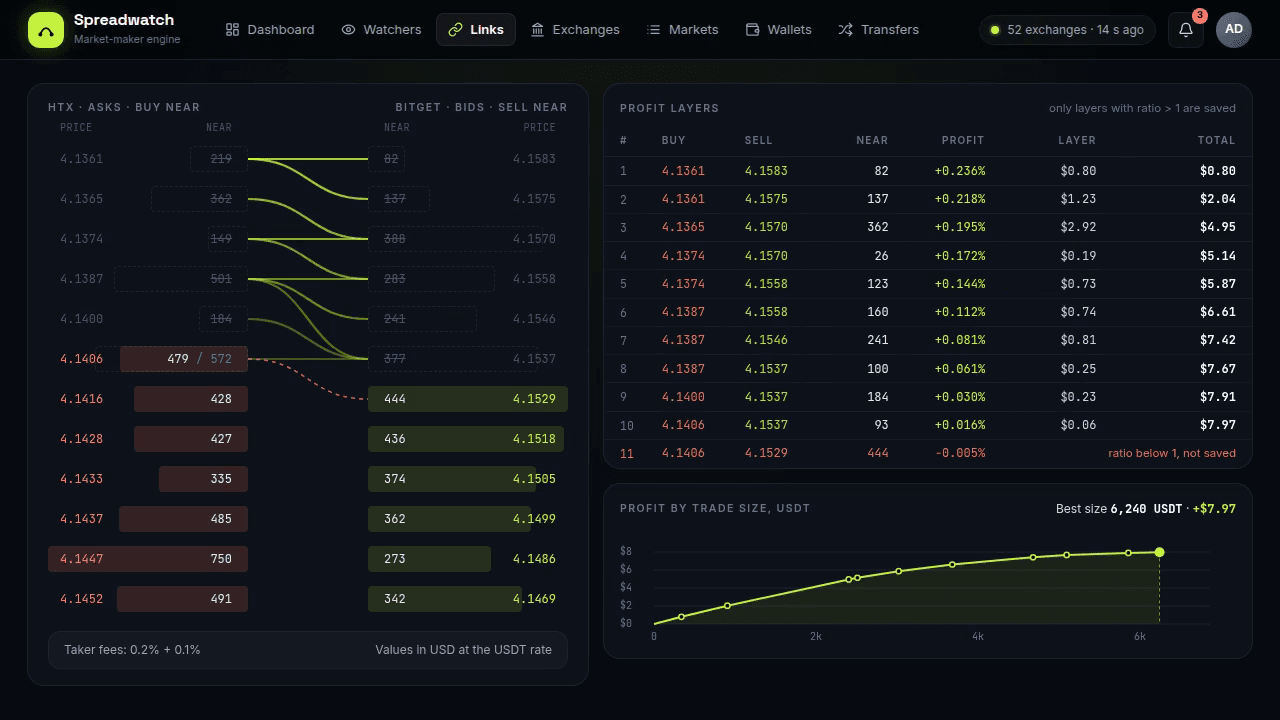
A good price at the top of the book can hide a thin market behind it. Profit is checked against live order books on both exchanges, so the engine shows how much can be traded before the gap closes.
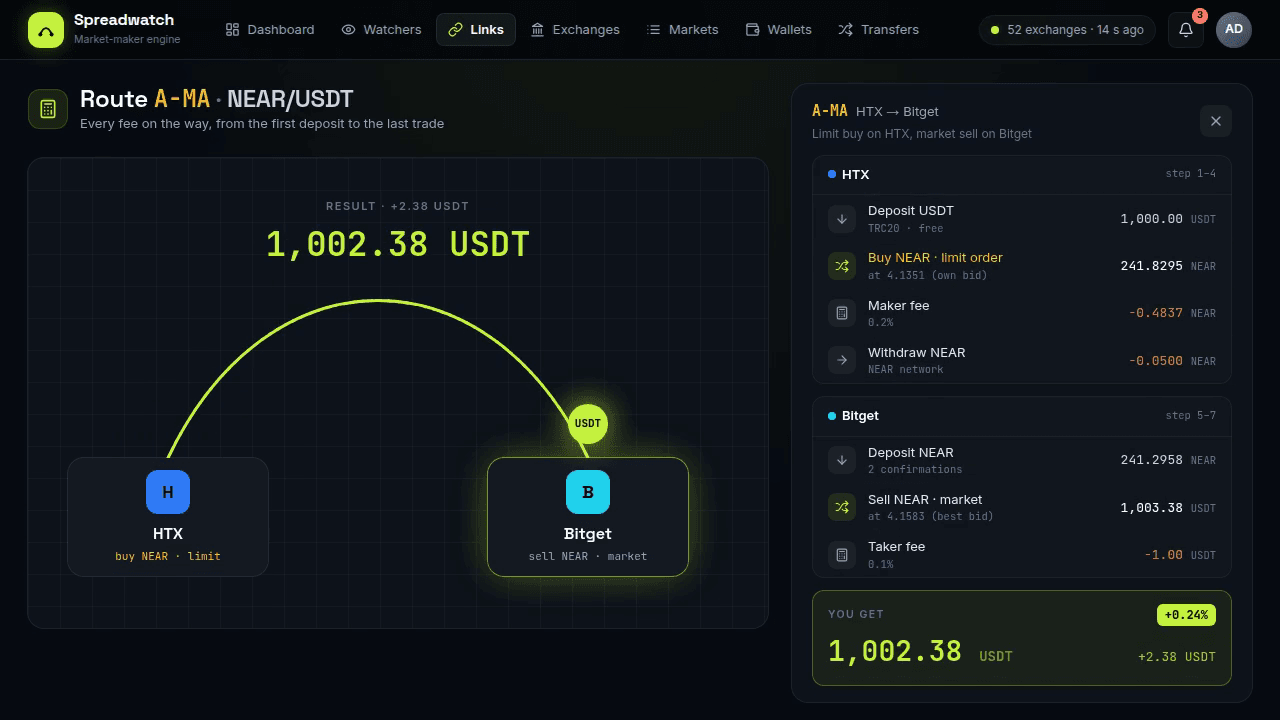
A calculator follows one trade from the first deposit to the final sale and counts trading fees, withdrawal costs and transfer time. A gap is judged on the money that arrives, not on the difference in prices.
When a gap gets large enough, the engine starts watching it: how big it gets, how long it stays open, with a sound alert when it appears. A transfer tool shows the cheapest way to move funds between two exchanges and whether their wallets accept deposits and withdrawals.
Market data comes from a service of its own with one adapter per exchange, so adding an exchange does not touch the pricing code. The pricing code is covered by tests.
In motion
Quotes on both exchanges keep moving, and every trade scenario is repriced as they do. When a gap crosses 1%, a watcher starts and an alert sounds.
The calculator follows 1,000 USDT from the first deposit to the final sale and takes off every fee and transfer cost along the way.
Both order books are checked against each other, and the profit curve shows the trade size at which the gap stops paying.
See it in action
The outcome
Send a short brief about your project. Within 24 hours you get an estimate or a clear next step, even if we don't work together.